
Calgary home‑buyers are staring at a 5‑year variable rate that drops to 3.65% as of this writing, more than 0.75% below the average 5‑year fixed rate of 4.49%. That gap can mean big savings, but it also brings risk. Below is a quick look at today’s rates, how they work, and what to check before you lock in a mortgage.
Table of Contents
- What Are Mortgage Rates and Why They Matter in Calgary
- Current Mortgage Rate Landscape in Calgary (July 2026)
- How to Choose the Right Mortgage Rate Type for Your Situation
- Understanding Fixed vs Variable Rates and Their Impact in Alberta
- How DreamHouse Realty Can Help You Handle Calgary Mortgage Rates
- FAQ
- Conclusion
What Are Mortgage Rates and Why They Matter in Calgary
A mortgage rate is the interest percentage a lender charges on the money you borrow to buy a home. It determines how much of each payment goes toward interest versus reducing the principal balance. In Calgary, the rate you lock in affects your monthly cash flow, the total cost of the home, and how quickly you build equity.
Rates are set by banks, credit unions, and mortgage brokers. They react to the Bank of Canada’s overnight rate, bond yields, and market expectations. When the rate rises, monthly payments climb; when it falls, you save money.
Understanding the mechanics helps you avoid surprise payments. Rapid interest‑rate changes can strain household budgets, especially for borrowers with low down payments. That’s why a clear picture of today’s numbers matters.
And if you’re looking for homes in a specific part of the city, the NW Calgary market guide shows where inventory is tight and which neighbourhoods see the most price movement.
Current Mortgage Rate Landscape in Calgary (July 2026)
Big banks keep their posted 5‑year fixed rates between 6.09% and 6.49%, while variable rates hover around 4.6%‑4.8% for insured mortgages. Actual offerings and promos rates are lower. Credit unions add special programs that can shave a few points off the headline rate or return a portion of interest as cash‑back.
4.49% average 5‑year fixed rate in Calgary
The Bank of Canada’s overnight rate has sat at 2.25% since June 2026, keeping the prime rate steady at 4.45% across the province. Variable mortgages track that prime rate, so they stay near today’s posted rates 4.6%‑4.8% range unless the central bank moves again.
How to Choose the Right Mortgage Rate Type for Your Situation
First, write down three numbers: your current credit score, your planned down payment, and how long you expect to stay in the home. Those three figures steer the decision.
If your score sits above 720, lenders will usually give you the best discounts on both fixed and variable products. If you can put down 20% or more, you’ll avoid mortgage default insurance and may qualify for lower variable discounts.
Next, think about your income stability. A steady job and predictable cash flow make a variable rate easier to manage because you can absorb modest payment swings. If your income fluctuates or you plan to move within a few years, a fixed rate offers certainty.
Finally, run the numbers to get an idea. Use an online calculator to compare a 5‑year fixed at 4.49% with a variable at 3.99% for a $500,000 loan over 25 years. The variable option saves a few hundred dollars each month, but you must be comfortable with the possibility of a rise.
Below is a quick video that walks through the calculation step by step:
Remember, many lenders let you switch from variable to fixed without a penalty if rates start climbing. That flexibility can be a safety net.
Pro Tip: Ask your broker whether the variable discount is locked for the whole term. Some lenders let you keep the same discount even if the prime rate moves.
Understanding Fixed vs Variable Rates and Their Impact in Alberta
A fixed‑rate mortgage keeps the interest percentage the same for the whole term , usually five years in Calgary. Your payment never changes, which makes budgeting simple.
A variable‑rate mortgage ties the interest percentage to the prime rate, which the Bank of Canada sets. In Alberta, the prime is 4.45% as of July 2026. Lenders subtract a discount (often 0.5%‑0.9%) to arrive at the advertised variable rate.
Because variable rates follow the prime, they tend to be lower when the economy is calm. Right now, the lowest variable rate is 3.65% at RBC Royal Bank , an outlier that sits well below the 5‑year fixed average.
But variable rates can rise. If the Bank of Canada lifts its overnight rate to combat inflation, the prime will climb, and so will your mortgage payment. That risk is why some borrowers lock in a fixed rate even when the headline number looks higher.
Penalty structures differ, too. Breaking a fixed‑rate mortgage early can cost you three months’ interest on the remaining balance, while a variable mortgage usually only charges a three‑month interest penalty. If you think you’ll move or refinance early, the lower penalty may sway you toward a variable product.
Credit unions add a twist. ATB’s 5‑year cashback mortgage returns a portion of the interest as a lump‑sum rebate at closing. Vision Credit Union’s profit‑share program gives borrowers back up to 25% of the interest they pay. Those incentives don’t lower the headline rate but improve the effective cost.
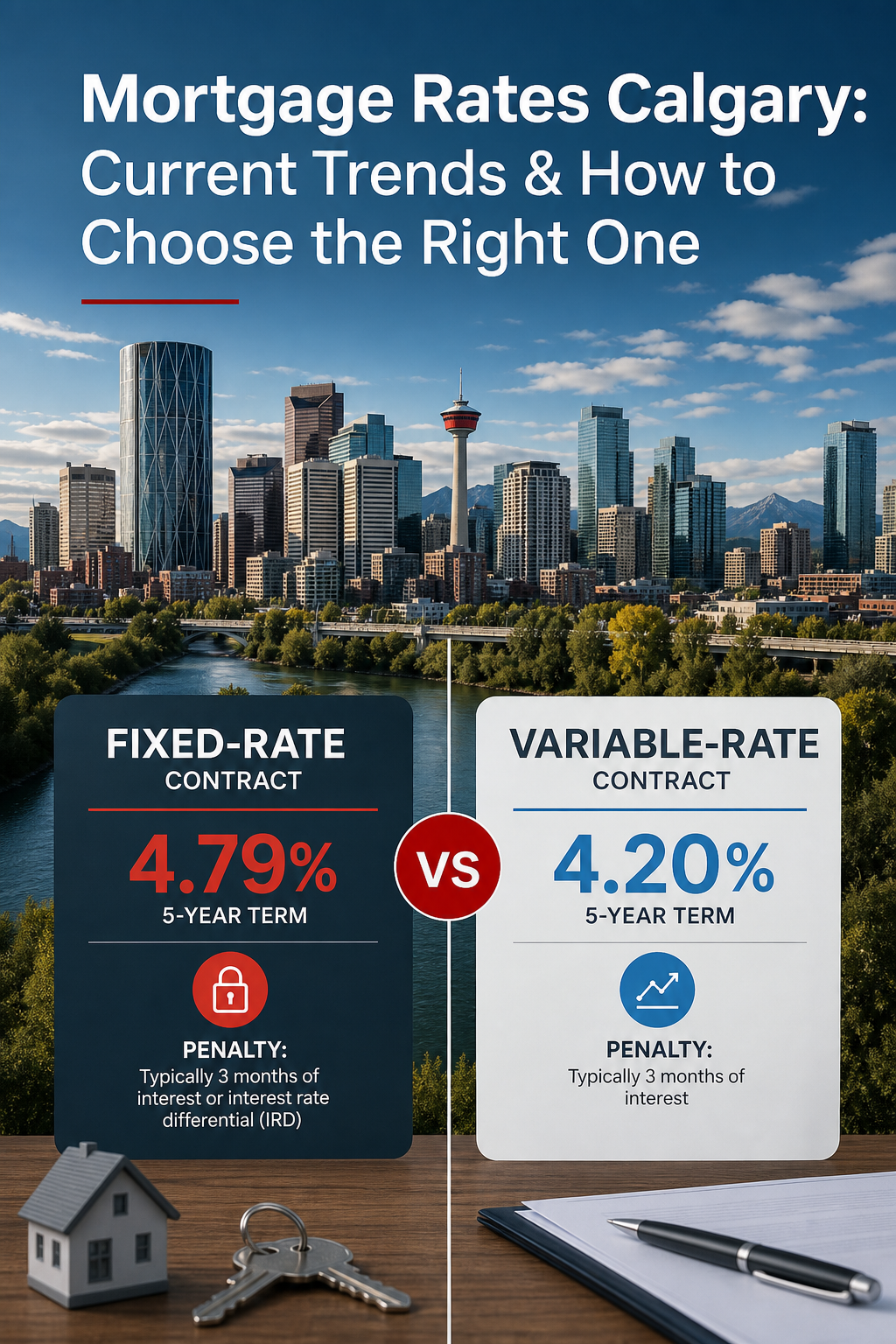 When you compare the two, ask yourself three questions: Do you need payment certainty? Can you handle a possible increase? How long will you stay in the home? The answers guide you to the right product.
How DreamHouse Mortgage Can Help You Handle Calgary Mortgage Rates
DreamHouse Mortgage is a local brokerage that works with a network of mortgage specialists and their in house team of Dreamhouse Mortgage. Their team pulls rates from every major bank, credit union, and boutique lender, then runs a side‑by‑side comparison for you.
Because they act as a broker, DreamHouse Mortgage can negotiate discounts that you might not see on a bank’s website. They also explain the fine print on special programs, like ATB’s cashback or Vision’s profit‑share.
The brokerage’s mortgage portal lets you plug in your credit score, down payment, and desired amortization. In seconds you get a list of rates that match your profile, plus an estimate of monthly payments under both fixed and variable scenarios.
Beyond numbers, DreamHouse Mortgage guides you through the pre‑approval process. They gather income documents, verify employment, and submit the file to multiple lenders, reducing the time you spend on paperwork.
 If you’re scouting specific neighborhoods, the townhome guide breaks down price trends and inventory levels. For a broad market view, the Calgary MLS listings page shows the latest homes on the market and lets you filter by price, bedroom count, and school district.
DreamHouse Realty also offers a free home‑value evaluation. Knowing your property’s worth helps you negotiate a better mortgage and plan for future equity growth.
FAQ
What is the current average 5‑year fixed mortgage rate in Calgary?
The average 5‑year fixed rate across the major lenders sits at about 6.17% as of July 2026.
How low can a variable mortgage rate go in Calgary?
The lowest advertised 5‑year variable rate is 3.65% from RBC Royal Bank, which is more than two points below the fixed‑rate average.
Do I need a down payment of 20% to get the best rate?
A 20% down payment removes the need for mortgage default insurance and usually unlocks the deepest discounts, but many lenders still offer competitive rates to borrowers with as little as 5% down if they have a strong credit score.
Can I switch from a variable to a fixed mortgage without penalty?
Most lenders allow a penalty‑free conversion from variable to fixed during the term, but you should confirm the exact policy with your broker before you sign.
What are the typical penalties for breaking a fixed‑rate mortgage early?
Breaking a fixed‑rate mortgage generally costs three months’ interest on the remaining balance, though the exact formula can vary by lender.
Are credit‑union special programs worth the extra paperwork?
Programs like ATB’s cashback or Vision’s profit‑share can lower your effective cost by 5%‑25% of interest paid, making the extra steps worthwhile for many borrowers.
Conclusion
Calgary’s mortgage market offers a tight spread between fixed and variable products. If you value payment stability, a fixed rate near 4.49% makes sense. If you can handle modest swings and want to save on interest, the variable market , especially the 3.65% outlier, is attractive. Talk to DreamHouse Mortgage to run a side‑by‑side comparison, lock in the best terms, and move forward with confidence.